
How to Style Cottage Decor Pieces: A Cozy Guide
Table of Contents
- Start With a Soft, Layered Base
- Cottagecore Decorating Ideas for Every Room
- How to Style Cottage Decor Pieces on Shelves and Tables
- Modern Cottage Style: Mixing Old and New
- Cottage Living Room Decorating Ideas That Feel Collected
- Affordable Cottage Style Home Accents on a Budget
- Common Mistakes to Avoid When Styling Cottage Decor
- Conclusion
- Frequently Asked Questions
Last Updated: October 16, 2026
Start With a Soft, Layered Base
Cottage decor is a warm, collected style built on soft colors, natural textures, and pieces that feel gathered over time rather than bought in one trip.
The trick most people miss is sequence. They buy the pretty accents first, then wonder why the room feels cluttered. Start with the base instead.
Here is what that base looks like:
- Soft, muted colors: cream, oatmeal, sage, dusty blue
- Natural materials: wood, cotton, linen, woven fibers
- One or two vintage or antique finds for character
A soft base gives every piece you add later somewhere to belong. According to the principles of color and design, muted tones recede while bright ones jump forward, which is why quiet palettes feel restful.
Get the base right and the rest gets easy.
Cottagecore Decorating Ideas for Every Room
Cottagecore decorating ideas work best when you treat each room as its own small story. The style should feel cozy and comfortable, not staged. A few thoughtful touches per room beat a full overhaul every time.
Start with the rooms you actually use.
Bedroom and Reading Nook Styling
A bedroom or reading nook needs three things: softness, texture, and one personal object. Layer a quilted throw across the bed or chair, add a floral pillow cover, and lean a vintage-inspired print against the wall.

The White Clover Botanical Interchangeable Rectangle Pillow Panel swaps in seconds for a fresh botanical look. It pairs well with woven baskets and warm wood.
Kitchen and Entryway Touches
Kitchens and entryways reward small, useful pieces. Think a ceramic pitcher, a linen towel, or a bowl of fresh greenery. These spots get the most traffic, so keep styling simple and practical.
- A wooden bowl with fruit or herbs
- One framed botanical print
- A candle for warmth
How to Style Cottage Decor Pieces on Shelves and Tables
Styling cottage decor pieces is a repeatable process, not a talent. The keyword here is pieces, individual objects, so this section walks through choosing, grouping, and placing specific items on the surfaces you actually style: shelves, mantels, bedside tables, entryways, and dining tables.
The 5-Step Styling Process (Works on Any Surface)
- Clear the surface completely. Empty it. You cannot see proportion on a cluttered shelf.
- Choose a focal anchor. One piece that carries the story, a framed botanical print, a ceramic pitcher, a vintage clock. Place it off-center, roughly one-third from one edge. Centered anchors read as formal; cottage style reads as collected.
- Add a medium companion. A stack of two or three books, a small crock, a woven basket. Its height should land between 60% and 80% of the anchor's height.
- Add a small accent. A bud vase, a candle, a single stem in a bottle. Roughly 40% to 60% of the anchor's height.
- Remove one thing. Step back. If the group feels busy, take away the item you like least. Most cottage shelves are over-styled, not under-styled.
Scale, Proportion, and Visual Balance
The reason some cottage shelves look calm and others look chaotic is proportion, not taste. Three working ratios:
- Height variation: Tallest piece roughly 1.5x to 2x the shortest. If everything is the same height, the eye has nowhere to travel.
- Group spacing: Leave 5-8 cm (about 2-3 inches) between groups so each cluster reads as its own vignette.
- Surface coverage: Aim for roughly 60% filled, 40% empty. Negative space is what makes cottage styling feel airy instead of cluttered.
A clear focal point per surface is non-negotiable. One shelf, one hero. If two pieces compete for attention, neither wins.
The Rule of Three (and When to Break It)
Odd numbers look natural; even numbers look arranged. Group in threes, fives, or sevens. But break the rule when you have a strong pair, two matching candlesticks, two identical ginger jars, because symmetry can read as intentional cottage charm when the rest of the surface is asymmetric.
| Position | Role | Relative Height | Cottage Example |
|---|---|---|---|
| Back | Anchor | Tallest (100%) | Framed botanical print, tall pitcher |
| Middle | Companion | 60-80% | Stack of vintage books, small crock |
| Front | Accent | 40-60% | Bud vase, candle, single stem |
Room-by-Room Application
Open shelves (kitchen or living room): Style in threes per shelf, but stagger across shelves so the eye zigzags.
Mantel: Treat the mantel as one long vignette, not three separate ones.
Bedside table: Two objects maximum plus a lamp.
Entryway: One strong piece beats five small ones.
Dining table: A low centerpiece only. A ceramic bowl with fruit, a linen runner, and one candle.
Modern Cottage Style: Mixing Old and New
Modern cottage is the substyle most readers actually mean when they say "cottage decor," but it is rarely defined against its cousins. Getting the substyle right is what keeps your decor pieces consistent, a coastal cottage shell should not sit next to a heavy English country tapestry and expect to feel intentional.
The Four Cottage Substyles at a Glance
| Substyle | Palette | Signature Pieces | Best For |
|---|---|---|---|
| Modern cottage | Cream, warm white, soft black, one muted accent | Clean-lined sofa, vintage wood table, simple ceramics | Newer homes, small spaces, renters |
| Cottagecore | Sage, butter yellow, dusty rose, floral-forward | Quilts, dried flowers, gingham, embroidered linens | Romantic, layered, maximalist-leaning rooms |
| English country | Deep greens, brick red, mustard, chintz | Rolled-arm sofas, paisley, brass, oil paintings | Older homes with architectural character |
| Coastal cottage | White, sand, faded blue, driftwood tones | Slipcovered seating, jute rugs, glass jars, rope details | Beach houses, sunrooms, bright airy spaces |
You can borrow from more than one, but pick a primary. Two substyles mixed evenly read as confused; one primary plus one accent reads as collected.
Pair Of Swans In Morning Mist →
How Modern Cottage Actually Mixes Old and New
The contrast is the point. A brand-new sofa looks warmer next to a flea-market side table. A crisp white wall softens beside a chipped, worn finish. The mechanism is simple: new pieces supply clean lines and function; old pieces supply patina and story. Remove either side and the room tips, all-new feels staged, all-old feels like a museum.
A few working rules keep the mix from feeling random:
- Keep the palette tight. Three tones maximum, usually one neutral base, one wood tone, and one muted accent.
- Balance one modern piece with one vintage piece per vignette. Not per room, per grouping. This is what makes the mix feel deliberate at close range.
- Let handmade accents carry the personality. A hand-thrown mug, a woven basket, a quilted throw. These are the pieces that stop a modern cottage room from looking like a catalog page.
What Modern Cottage Is Not
It is not minimalism with a wood bowl. Modern cottage still layers, it just edits harder than cottagecore. It is also not farmhouse. Farmhouse leans on signage, galvanized metal, and a stricter black-and-white palette; modern cottage leans on warm neutrals, natural texture, and one or two vintage pieces per surface.

This is also why modern cottage ages slowly. It is not chasing a trend year, it is borrowing from decades that already proved they last.
Cottage Living Room Decorating Ideas That Feel Collected
Cottage living room decorating ideas should feel gathered, not bought. The best cottage living rooms look like they grew over time.
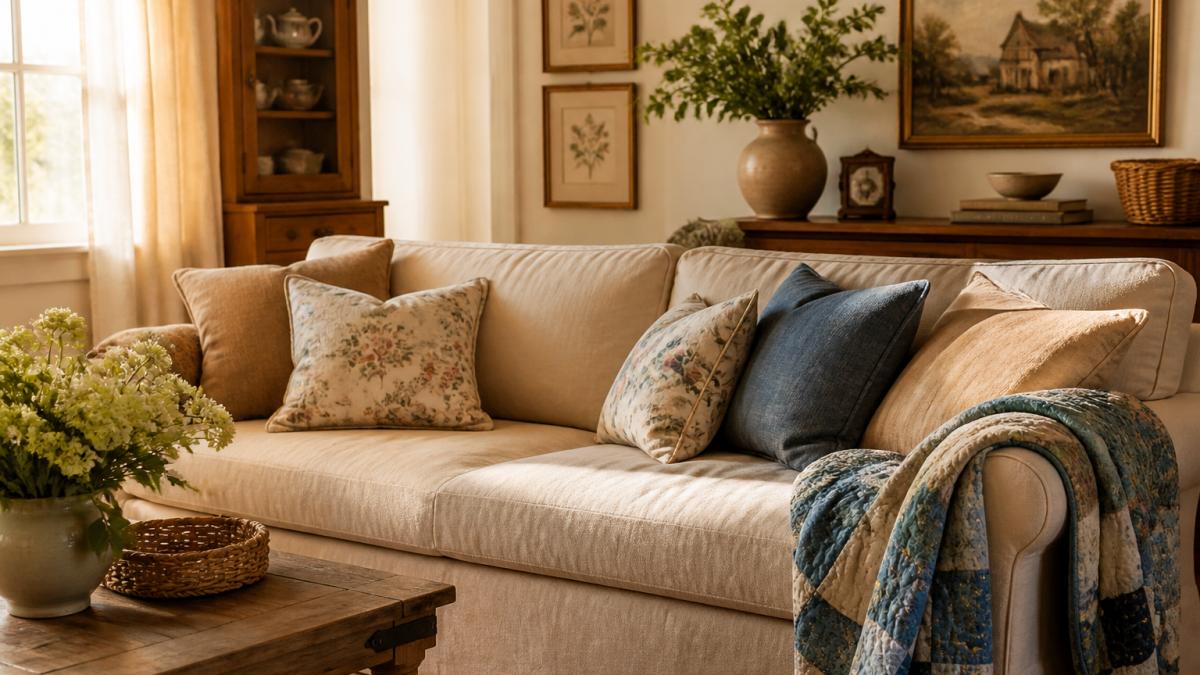
Start with the sofa. Add a floral pillow cover, then a solid one, then a textured one. Drape a quilted throw over one arm.
The Pair Of Swans In Morning Mist print brings that old-world, English country feel. Its soft, misty landscape adds calm without competing with your textiles.
Layering Textures and Patterns
Texture and pattern are what make cottage decor feel rich. Mix a floral print with a stripe, or a paisley with a solid. The trick is to keep colors shared even when patterns differ.
Layer these together:
- A floral pillow next to a solid linen one
- A woven basket beside a smooth ceramic
- A quilted throw over a plain cotton sofa
The Tache Petal Dance Floral Patchwork Quilted Throw Blanket does this in one piece. Soft blue florals, paisley, and patchwork sit together with scalloped edges and vermicelli stitching.
Affordable Cottage Style Home Accents on a Budget
Affordable cottage style home accents come from smart swaps, not big spending. You do not need a full overhaul. A handful of small changes can shift a whole room.
Try these budget moves:
- Swap pillow covers instead of buying new pillows
- Repurpose jars, crates, and baskets you already own
- Shop flea markets for one character piece
Switching pillow covers is the single easiest update. The Hanging Lavender Spring Pillow Cover refreshes spring decor and works year-round. It is an 18x18 inch poly/cotton cover with a muted lavender design on an oatmeal background.
Common Mistakes to Avoid When Styling Cottage Decor
The biggest styling mistakes come from doing too much at once. Cottage decor should feel calm, and calm comes from restraint.
Watch for these:
- Buying accents before the base is set
- Using too many patterns in clashing colors
- Filling every surface with no breathing room
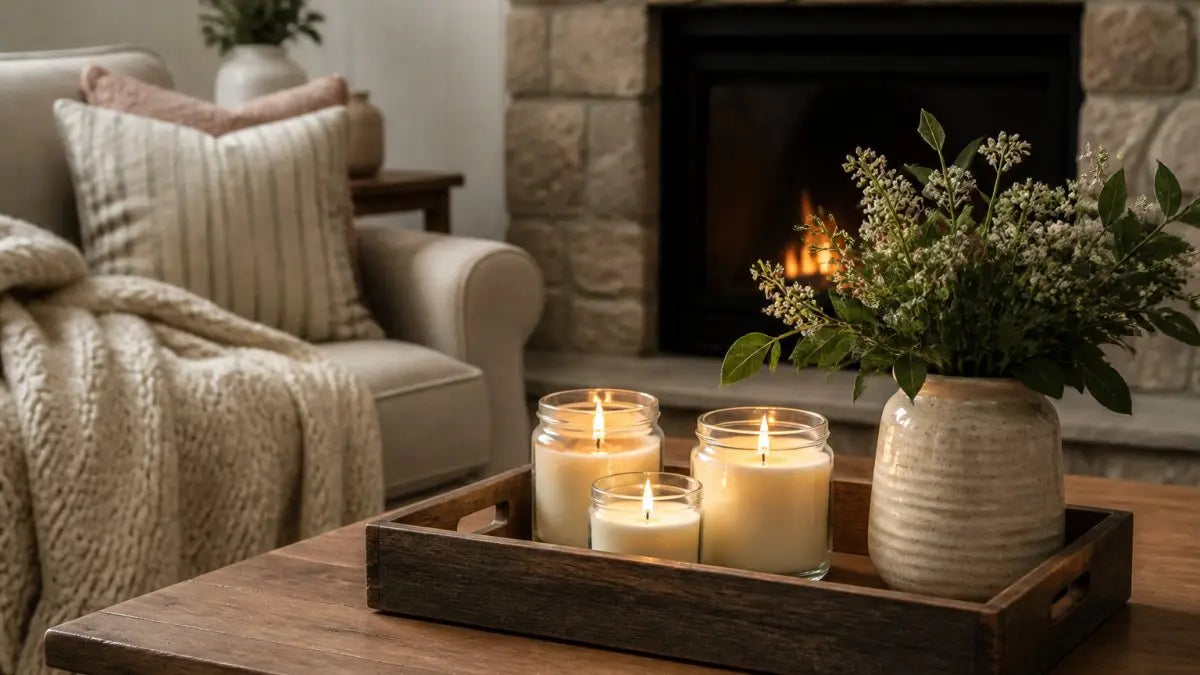
There is also a practical side. Check that shelves are fixed securely before loading them with heavy pieces. Keep candles away from textiles and out of reach of children and pets (Candle fire safety week: snuff out the fire risk). Style for real life, not just for photos.
Conclusion
Cottage decor rewards patience. Build a soft base, layer textures and patterns, mix old with new, and let each piece earn its place. The rooms that feel most collected are the ones styled slowly, over time.
At KJ Cozy Designs, we curate farmhouse and cottage-style pieces made to bring warmth and calm to every room. Our collections focus on quality, simplicity, and comfort, with free shipping on orders over $50 and a 30-day return policy.
Frequently Asked Questions
How do I style cottage decor without making a room feel cluttered?
Edit as you go. Group items in odd numbers, vary heights, and leave breathing room between clusters. Choose one focal point per surface, like a floral pillow cover or a piece of wall art, then add one or two supporting pieces. Rotate seasonal items instead of displaying everything at once. A collected look comes from restraint, not volume. If a shelf or table feels busy, remove one item and see how the space opens up.
What colors and materials work best for cottage-style decorating?
Soft, muted colors set the tone: oatmeal, sage, faded blue, cream, and blush. Natural materials like cotton, linen, wood, and woven fibers add warmth and texture. Floral prints and botanical motifs reinforce the cottage feel without shouting. Layer these with vintage or antique finds that show worn finishes and character. A muted multicolor lavender design on a natural oatmeal background, for example, blends easily with neutral and farmhouse styles.
How can I add cottage style to a room on a budget?
Start with what you already own. Rearrange furniture, swap pillow covers instead of buying new pillows, and repurpose jars or baskets as display pieces. Affordable cottage style home accents like an 18x18 inch pillow cover at $22.99 or a botanical pillow panel at $16.99 can refresh a room for less than a new lamp. Flea-market finds and handmade accents add character without a big spend. Focus on one or two updates per season.
Will cottage decor pieces work if my home is a mix of styles?
Yes. Cottage decor is naturally adaptable. A vintage-inspired piece like the Pair of Swans in Morning Mist wall art complements English country, traditional, farmhouse, and vintage interiors. You do not need a full overhaul. Introduce one or two pieces that share a common thread, such as soft colors or natural materials, and let them bridge the gap between your existing style and the cottage look. Start small and build from there.

Leave a comment
This site is protected by hCaptcha and the hCaptcha Privacy Policy and Terms of Service apply.